
HIKING UP IS MANDATORY: RIM TO RIM HIKE OF THE GRAND CANYON
One sign at the top of North Kaibab trail to the Grand Canyon warns: “Hiking down is optional. Hiking up is mandatory.” A second sign nearby ominously cautions that the National Park Service does not recommend anyone attempt to hike from one rim of the Grand Canyon to the other. It’s no exaggeration to report that people die every year hiking in the Grand Canyon. It’s harsh. It can be intolerably hot, sucking the energy from anyone attempting to hike in temperatures that can reach well above 120 degrees. As one blogger famously put it in a warning letter, it’s like a marathon, except that unlike a “comfy marathon” if you get sick, or exhausted, or want to quit, or you twist an ankle or your knee gives out, you can’t call a taxi to take you back to your hotel. No one is coming to get you. “You are your own rescue.” https://www.r2r2r.org/jeans-annual-warning-letter Hiking out is mandatory.
The rim to rim, or R2R is a through hike from one rim of the Grand Canyon to the other. Although it can be accomplished in a few days by camping or staying overnight in cabins at Phantom Ranch, the real test of R2R is accomplished in a day. One. Long. Day.
Because R2R is a grueling test, covering more than 26 miles and 12,000 feet of elevation change, the beginning of the hike actually starts months before the day you have selected to go. You will need to be in great shape. It’s recommended you build up hiking or running to comfortably completing at least 10 miles multiple times before you go. Many people use training protocols published for marathons. That’s a good way to prepare. Don’t underestimate how hard it is, or that you need to be in great shape and able to hike for half a day.
The list of necessities is fairly simple: really good shoes (boots are not needed. Tennis shoes or trail runners are great). TWO PAIR of great socks. A hat. Sunglasses. Sunscreen. A headlamp, as it is likely you will either start or end your hike in the dark. A hydration pack with at least a 2L bladder and some room for light salty snacks…nuts, chips, nutrition bars. An apple. Raisins. Keep it light. Someone in the group should bring a first aid kit.
Logistics: the North Rim is significantly higher (1300 feet!) than the South Rim. The few who attempt R2R in a day recommend hiking north to south for that reason. Hiking south to north leaves the greatest elevation for last. That is like deciding to add climbing a 130 story building after hiking more than 20 miles.
You should plan to stay at or near the North Rim. There is lodging at the North Rim which has to be reserved well in advance. https://www.grandcanyonforever.com/ There is lodging just outside the park gates (https://kaibablodge.com/ ) Jacob Lake (https://www.jacoblake.com/ ) or Kanab, 75 miles away.
You will need to either arrange for someone to drop you off at the North Rim and drive your car around the canyon to the South Rim to pick you up on the South Rim, or hire a shuttle to return you to your car. While the distance straight across is about 12 miles, the drive from North Rim to South Rim is 220 miles and takes about 5 hours. Shuttles can be booked in advance at https://www.trans-canyonshuttle.com/, or at the Kaibab Lodge, listed above. Your only other option is to hike back to your car, thus performing the rare R2R2R!
It is estimated the hike will take between 12 and 15 hours. Unless you begin before sunrise, and many do, the hike will likely end just before or after sunset. Hotel rooms on the south rim are expensive, must be booked months in advance, but are a singularly spectacular experience. Several restaurants are available on the south rim.
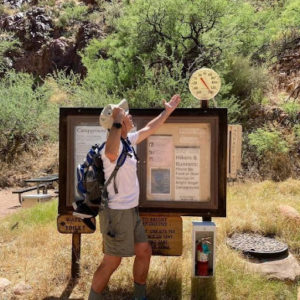
One consideration that is critical is when to go. The North Rim is typically closed by snow, owing to elevation of 8803 feet, from November 1 until the second week in May. In summer the hike is dangerously hot. I’m pictured here on June 18 at Phantom Ranch, near the Colorado River. The temperature was over 130 degrees Fahrenheit! It was a mistake to hike in that temperature.
The recommended times are between May 15 and June 15 or September 15 until November 1. It’s not only not recommended, it’s just not safe to try a R2R hike between July 1 and September 1. But for a R2R hike, daylight becomes an issue later in the year, although the cooler weather in the fall is pleasant. Unless you are running R2R, and a handful of ultra trail runners do, you will want to leave at first light (or before) and expect to finish at sunset or after.
The Hike: Starting at the North Kaibab trailhead, a couple of miles from the North Rim Lodge, you can expect that the temperature will be cold at dawn, even in June. It’s not at all unusual to find a difference of more than 50 degrees from that point to when you reach Phantom Ranch, 13 miles later.
Although you eventually drop more than 6500 feet, there are few truly steep downhill places. The trail is, for the most part, gradually downhill. The dirt is beaten flat by years of hikers and daily mule teams which carry supplies to Park Service outposts and Phantom Ranch, and garbage and mail out. There are some steps built in by rock or logs to prevent erosion, but no difficult climbing or scrambling is necessary.
While the hike is a test, don’t forget to enjoy it and appreciate being in one of the most spectacular places on earth. The vistas are incredible. The colors change with the changing light. Each corner in the trail presents a new wonder. The power of nature carved this out over centuries of time. Amazing. Incomparable.
Water is available most of the time every two or three miles. There are breakdowns that occur to the system of pipes carrying water from underground springs and creeks. Hikers are well advised to fill up at every opportunity, and to check with the National Park Service website to determine whether there are known breaks in the water system. Given the heat and the strenuous activity, being able to access water every two or three miles is about right. But a disruption in the water system stretches that to four to six miles, and careful rationing is necessary.
Hydration is key to a successful hike. The heat is relentless. Very little shade. It’s physically strenuous beyond anything most people ever experience. It’s a good idea to hydrate the day before the hike. Keep it going throughout the day of the hike. I’ve seen people who failed to hydrate sitting by the side of the trail, 5 miles from the top, staring straight ahead, looking as if they were completely spent.
The first half of the day is all downhill. From North Kaibab trailhead to Phantom Ranch is 14 miles. Most people stop there to rest in the shade, and many try the famous lemonade. A pro insider tip, however, is to walk a little farther down the creek towards the Colorado river. Where the trail crosses the creek heading up Bright Angel trail, just before the river there is a great restroom, and the creek is cold and makes for a beautiful place to rest. While the area around the canteen at Phantom Ranch can be crowded, this little stop, perhaps a mile farther, is usually empty. Sit in the creek, soak your feet, and enjoy a rest, because the next 9 miles is hell.
Colorado River to the top: Bright Angel Trail
Stand on the Silver Bridge crossing the Colorado River, tilt your head back and look up. The rim is the goal, but it is 9 miles to the top, and 4480 feet above you. By comparison, the Empire State building is 1250 feet tall…you would have to climb it more than 3.5 times before you reach the top. If you’re wondering, Burj Khalifa in Dubai is only 2716 feet! So just for fun, if you put the Empire State building on top of the Burj Khalifa and climbed to the top of THAT structure you would still be 50 stories short!
In the first mile, the River Trail runs along the Colorado river. It’s not unusual to see 3 or 4 large rafts floating down the river in a group. That trail is fairly flat and sandy in spots. Soon enough, it turns uphill to the River Resthouse. I have only hiked it twice, but water was not available either time. That means you have to begin the hike with a stretch of 4.7 miles without water. It may not seem like a big deal until the sun beats down and you hit your first sustained uphill stretch. Be sure to carry enough water and hydrate.
The first real rest stop after crossing the river is Havasupai Gardens. It is 4.8 miles from the top and is a great place to rest, get some water, get out of the sun for a bit, and mentally prepare for the hardest part of the hike.
The last 4.8 miles looks to be straight up a sheer cliff. Probably because it is. The trail is carved into the rock face of the cliff and becomes a series of switchbacks. The old adage is “How do you eat a whale? One bite at a time” is part of how I mentally handle the challenge of the last miles to the top. Instead of thinking that I have 4.7 miles from Havasupai Gardens, I think that it is only 1.7 miles to the Three Mile Resthouse. “I can do 1.7 miles! That’s easy!” I tell myself. And then, “It’s only 1.5 miles to the Mile and a half resthouse!” And one last mile and a half to the top. But along the way inevitably you will see people sitting by the side of the trail, vacant looks on their faces, completely spent. It’s as hard of a thing as most people will ever do.
The last 1.5 miles, actually is a little easier. The trail itself winds directly under the rim. Cell coverage resumes for the first time since you dropped into the canyon 12-15 hours ago. You can hear people talking and laughing at the top, right above you. Your restaurant may text to say your table is ready. Although utterly and completely exhausted, the euphoria of nearly being done with this grueling, spectacular hike is nearly over.
If you are fortunate enough to have completed the hike while it is light, stand at the top and look back across the canyon. In the distance you can see where you started early that morning. Look carefully, and you can follow the trail down the North Kaibab trail toward the Colorado. Peer over the edge, and you can follow most of the Bright Angel trail up from the river. It eventually disappears under the edge of the rim somewhere around the 3 mile resthouse.
If you finish after dark, or come back out from your hotel room after dark, you can look back out over the trail and can see evidence of the truth of the sign:” …hiking out is mandatory.” Back down the trail you will see flashlights, some more than 4 hours from the top. Not all were stragglers on a R2R hike. Some likely had hiked down from the south rim, and misjudged either the time or their own capabilities. In any event, no one was coming to get them, and whether they continued up for hours, stopped at Havasupai Gardens (the last spot that could be considered having campsites), or simply sat down next to the trail and waited for morning, eventually they would have to hike to the top on their own.
For many, seeing the Grand Canyon is on their bucket list. For a few, completing a hike from one rim to the other is a difficult physical test permitting a view of the canyon only a handful of people attempt. It’s an incredible journey. 